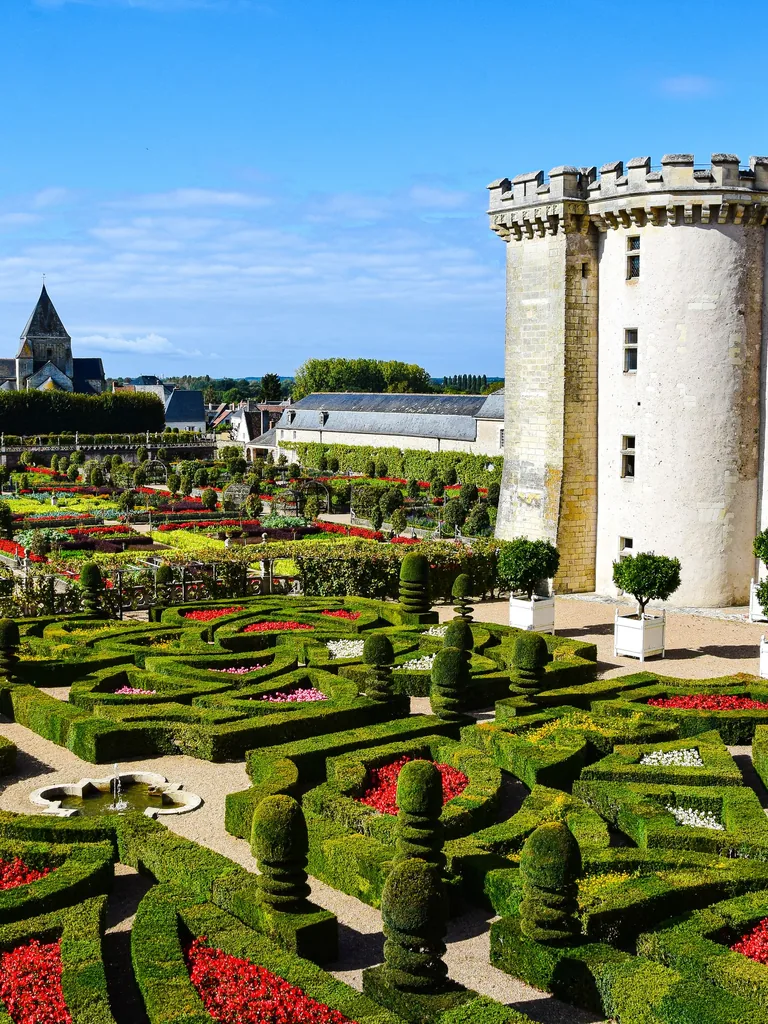
Loire Valley, France
Walk the terraces of France's most famous gardens
Six Renaissance gardens replanted twice a year, yours on any open day. We handle the booking.
- UNESCOLoire Valley World Heritage Site, 2000
- 16th c.One of the last great Renaissance châteaux on the Loire
- 6Themed gardens, from the potager to the maze
- 9Coloured squares in the ornamental kitchen garden
Tickets
Two terraces, one garden
The gardens ticket is the lower terrace: all six gardens, any open day. The château ticket is the upper terrace raised on it: the same gardens plus the Renaissance interior. Neither has a date or a time slot.
Lower terrace
Gardens only
All six Renaissance gardens (château interior not included)
€22per person
- Entry to all six gardens — potager, water, sun, herb gardens and the maze
- Your e-ticket by email — scan and walk in, no ticket-desk queue
- Valid any open day the gardens are open — including winter, when the château interior is closed
- concierge support in your own language
Upper terrace · adds the interior
Most chosenChâteau + Gardens
Château interior and all six gardens
€34per person
- Entry to the Renaissance château interior and all six gardens
- Your e-ticket by email — scan and walk in, no ticket-desk queue
- Valid any open day in 2026 — no fixed date, plans stay flexible
- concierge support in your own language before and during your visit
There's no daily cap here, so Villandry rarely sells out — the gardens simply peak from late spring to early autumn.
Visitors
The garden labels
-
Everything was perfect!
Daniela · US · August 2026 -
Todo perfecto, personal fantastico
José Antonio · Sevilla · August 2026
The gardens
Planted twice a year
Spring planting
Villandry is the last of the great Renaissance châteaux built on the Loire, finished in the 1530s for Jean Le Breton, a minister of François I. But people come for the gardens, not the walls.
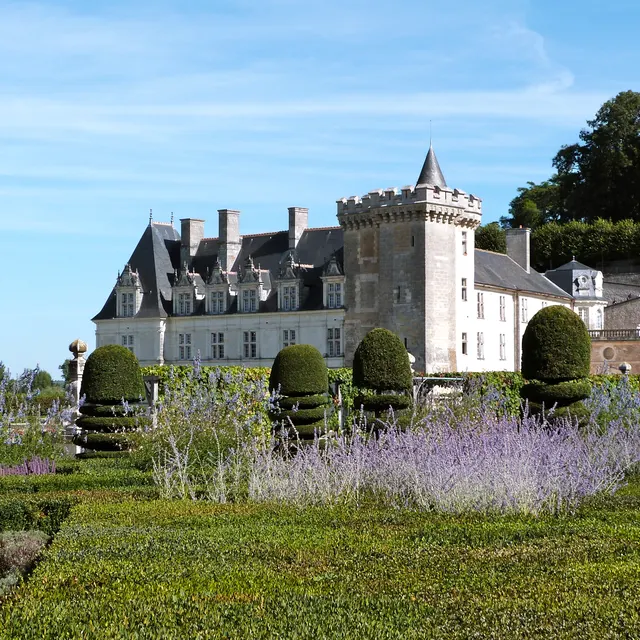
Autumn harvest
The gardens are laid out as six rooms on terraces above the river: the famous ornamental kitchen garden in nine coloured squares, the love gardens clipped into hearts and fans, a water garden, a sun garden, a herb garden and a maze. They were recreated in the early 1900s by Joachim Carvallo, who bought a half-ruined Villandry and spent the rest of his life restoring the Renaissance layout.
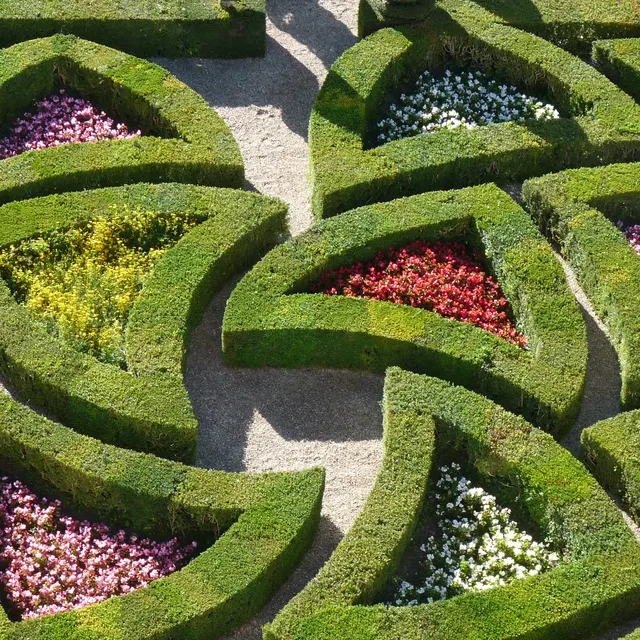
The kitchen garden is replanted twice a year, so the same visit looks different in June and September. From the château keep and the upper terraces you look straight down over the patterns — the view everyone comes for.
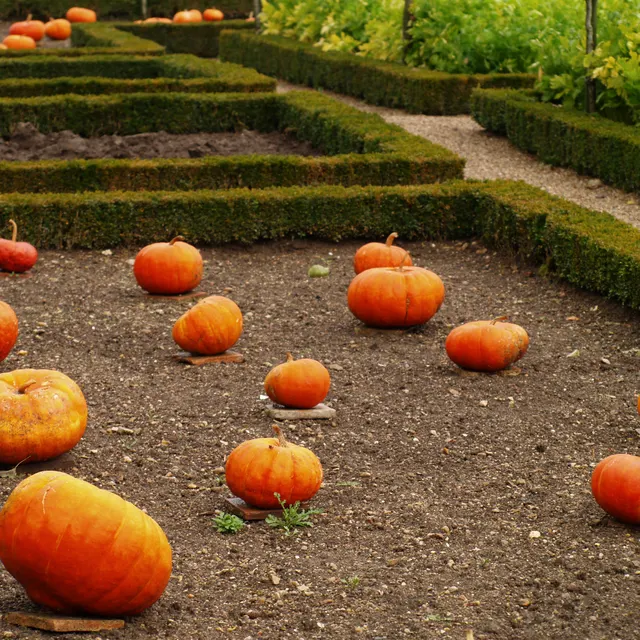
- Mobile e-ticket, straight inScan at the gate — no queue at the ticket desk to buy
- Valid any open dayNo fixed date and no daily cap — visit whenever suits you
- Six gardens in one ticketFrom the nine-square potager to the water garden and maze
Visitor guide
The espalier
Ten branches trained along the wall, one per thing a first visit asks. Open a branch.
The Château et Jardins de Villandry, in France's Loire Valley about 15 km west of Tours, is the last of the great Renaissance châteaux built on the Loire, finished around 1536 for Jean Le Breton, a minister of François I, and incorporating the surviving keep of an earlier medieval fortress. It is famous less for its walls than for its gardens: six terraced 'rooms' — the ornamental kitchen garden in nine coloured squares, the symbolic Garden of Love, a water garden, a sun garden with children's playground, a herb garden and a hornbeam maze — recreated in the early 1900s by Joachim Carvallo, whose family still owns and maintains the estate today. The kitchen garden is replanted twice a year, and from the 14th-century keep and the upper terraces you look straight down over the whole design.
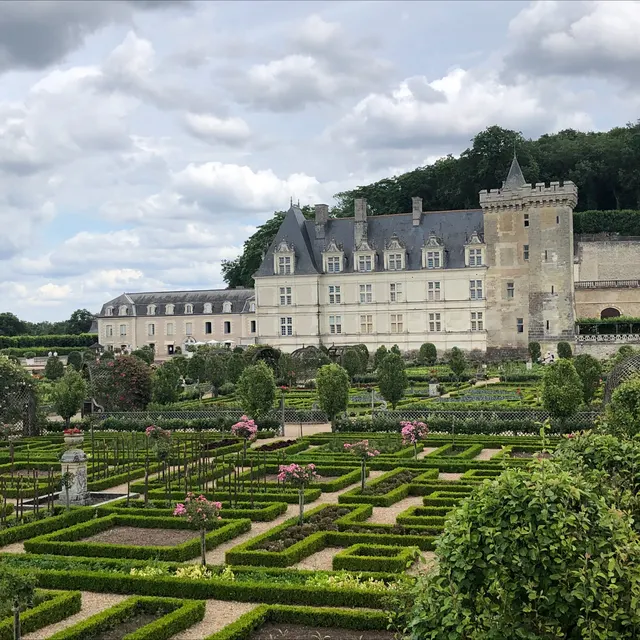 What is Château de Villandry?The Château de Villandry is the last of the great Renaissance châteaux raised along the Loire, completed around 1536 for Jean Le Breton, Controller-General for War under King François I.
The Château de Villandry is the last of the great Renaissance châteaux raised along the Loire, completed around 1536 for Jean Le Breton, Controller-General for War under King François I. Le Breton built his elegant new house around the surviving keep of an earlier medieval fortress, a tower where, generations before, Philip II of France is said to have met Richard I of England to negotiate peace. The Le Breton family held the estate for more than two centuries before it passed through later owners, was confiscated during the French Revolution, and was eventually acquired for a member of the Bonaparte family. Yet almost everyone who comes to Villandry today arrives for what surrounds the house rather than the house itself.
In 1906 Joachim Carvallo, a Spanish-born doctor, bought the then half-ruined estate with the support of his American wife, Ann Coleman, and devoted the rest of his life to restoring the château and re-creating an entirely new suite of Renaissance-style gardens across the surrounding terraces. He drew on historical garden treatises rather than any single surviving plan, and founded La Demeure Historique to champion France's privately owned heritage houses. The result is a set of six distinct garden 'rooms', arranged over several terraced levels above the river, that made Villandry world-famous. The Carvallo family still owns and maintains the estate, replanting the gardens season after season. Set in the Loire Valley about 15 km west of Tours, Villandry lies within the stretch of the valley inscribed as a UNESCO World Heritage Site in 2000.
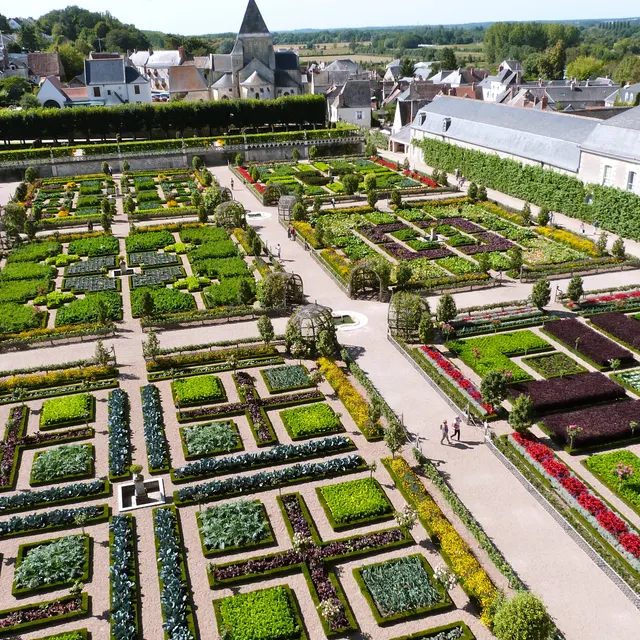 The Six Gardens — an OverviewVillandry's gardens are laid out as six themed spaces rising over several terraced levels above the river, each with its own character and mood.
Villandry's gardens are laid out as six themed spaces rising over several terraced levels above the river, each with its own character and mood. The best known is the ornamental kitchen garden, the potager, arranged as nine large squares of equal size, every one planted in a different geometric pattern using vegetables rather than flowers, chosen and set out for their colour and form. The vegetables are replanted twice a year, so the same nine squares look markedly different from one season to the next.
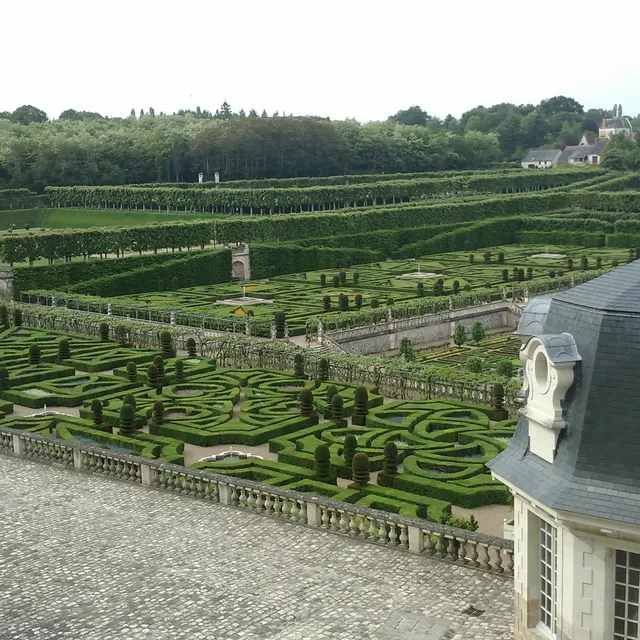
Above the potager lies the ornamental garden, or jardin d'ornement, home to the celebrated Garden of Love, where four box-hedge parterres each stand for a different kind of love, alongside a music garden and a herb garden of aromatic and medicinal plants. Higher still, the water garden centres on a large, calm classical pool that was historically a reservoir and is now valued for its stillness, a deliberate contrast to the geometric intensity below. The sun garden, on one of the upper terraces, is a warmer, more informal planting that also shelters the estate's children's playground. Threaded beside the ornamental garden, a maze cut from green hornbeam hedges leads to a central wooden viewing tower. Because the whole design is meant to be read from above, the upper terraces and the surviving medieval keep give the clearest view down over the patterns. Taken together, the six gardens form a living composition that repays slow, unhurried walking far more than a quick circuit.
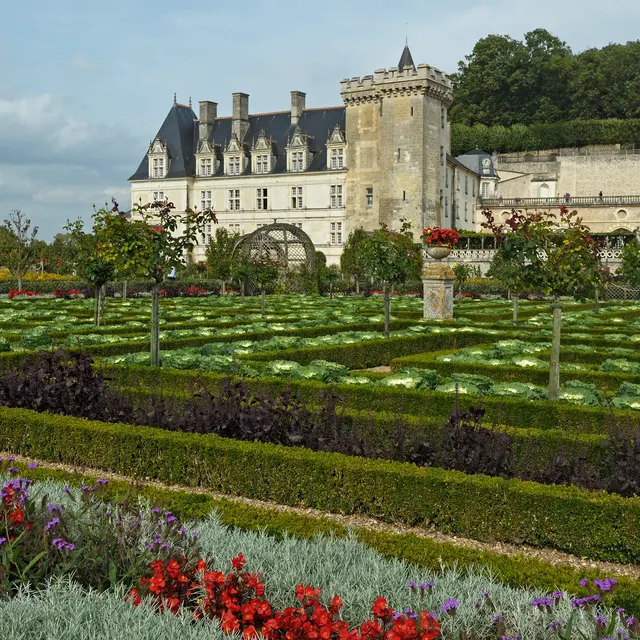 The Potager — the World's Most Famous Kitchen GardenThe ornamental kitchen garden is the reason most visitors come to Villandry, and it lives up to its reputation as perhaps the most photographed kitchen garden anywhere.
The ornamental kitchen garden is the reason most visitors come to Villandry, and it lives up to its reputation as perhaps the most photographed kitchen garden anywhere. Divided into nine squares of identical size but different internal designs, the potager treats vegetables the way a painter treats colour: blue-green cabbages set against burgundy lettuces, orange pumpkins beside deep purple aubergines, and the varied greens of different herbs used for tonal contrast rather than flavour. Roughly forty species of vegetable, drawn from several plant families, go into the display.
It is changed between plantings partly for visual variety and partly to protect the soil, so this is a genuinely working kitchen garden as much as a work of art. The spring planting, going in from around March, favours softer colours and quicker crops such as radishes, peas, oak-leaf lettuce, strawberries and chives, framed by pansies and forget-me-nots. The summer planting, which takes over from around June and holds into November, is bolder, with ornamental cabbages of many kinds, gourds, leeks and tomatoes edged with blue sage and rudbeckia. The finest way to appreciate the composition is from above: the upper terraces give a good view, but the château's medieval keep, reached with the combined château-and-gardens visit, offers the classic aerial outlook straight down over all nine squares at once. If your time at Villandry is short, this is the part of the estate to see first.
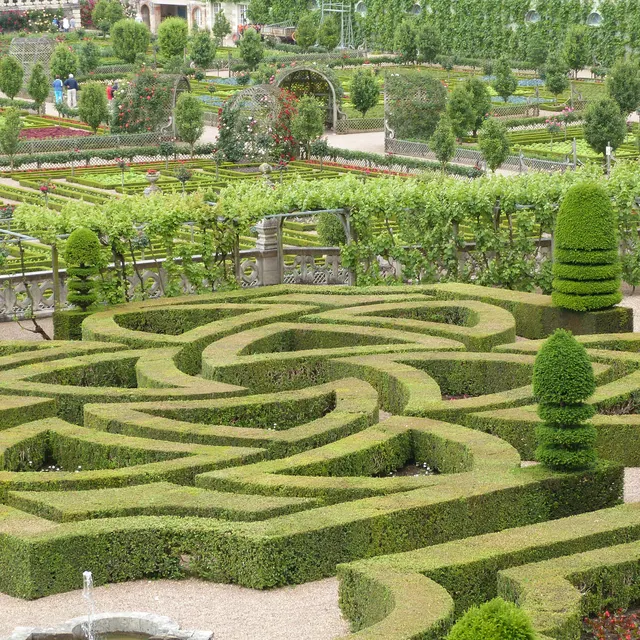 The Garden of Love — Renaissance Symbolism in Box HedgeOn the ornamental terrace, one of Villandry's most quietly remarkable features is the Garden of Love: four box-hedge squares, each a piece of readable Renaissance allegory rather than simple decoration.
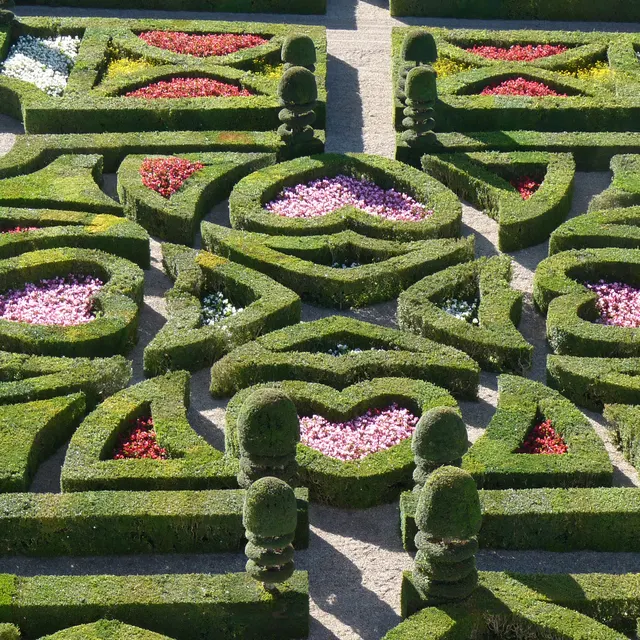
On the ornamental terrace, one of Villandry's most quietly remarkable features is the Garden of Love: four box-hedge squares, each a piece of readable Renaissance allegory rather than simple decoration. Tender Love is rendered as hearts separated by small flames, with masks at the centre of the design, the kind worn at Renaissance balls so that wearers could hold a conversation, earnest or flirtatious, behind a disguise. Passionate Love uses hearts broken apart by feeling, its box hedging tangled into a maze-like whirl that evokes the dance and disorder of infatuation.
Fickle Love is picked out with fans, wings and butterflies in the corners, symbols of shifting affection, set against a dominant note of yellow, the traditional colour of betrayal, with clipped 'love letters' at the centre standing for the lighter side of romantic exchange. Tragic Love is the starkest of the four: box clipped into the shape of duelling dagger blades, with red flowers standing in for bloodshed. Few gardens anywhere let you walk through a piece of symbolic storytelling this directly, and the meaning only fully reveals itself when you slow down and look. The parterres sit beside the music garden and the herb garden, so the whole ornamental terrace rewards careful attention rather than a hurried photograph. Freshly clipped in spring, the box hedges hold their crisp geometry through the season, and reading the four squares in turn is one of the quieter pleasures of a Villandry visit.
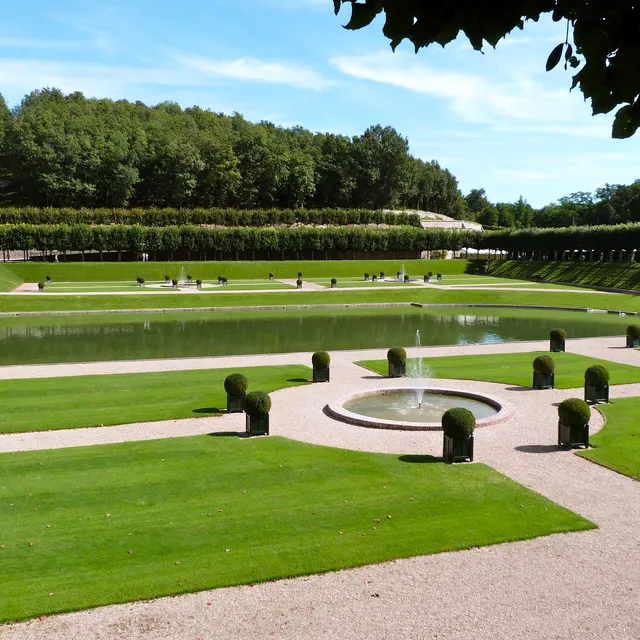 The Water Garden, Sun Garden and MazeThe water garden occupies one of the highest terraces at Villandry: a large, calm pool in a classical style, framed by lawns and originally built as a practical reservoir for the estate.
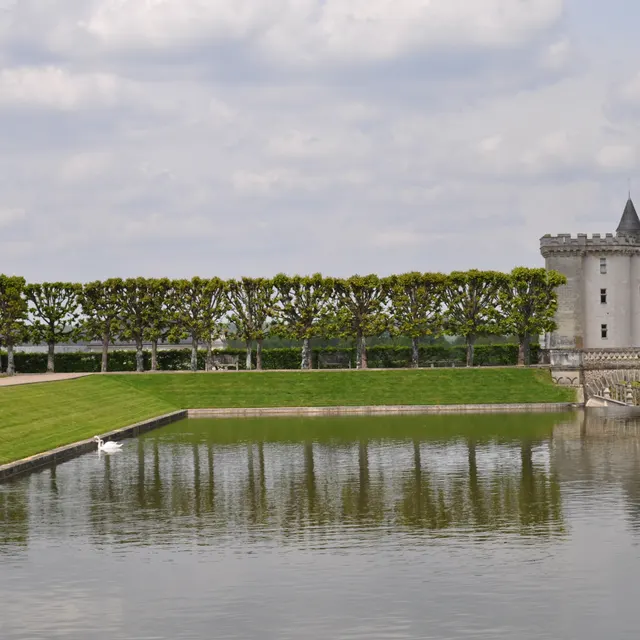
The water garden occupies one of the highest terraces at Villandry: a large, calm pool in a classical style, framed by lawns and originally built as a practical reservoir for the estate. Today it serves as the garden's quiet counterpoint. After the visual density of the potager and the symbolism of the Garden of Love, the water garden is simply still and reflective, a place to pause rather than hurry through. The sun garden, on one of the upper terraces, uses warmer, more informal plantings and also shelters the estate's children's playground, a useful and welcome rest point for families partway through a visit that otherwise involves a good deal of careful, slow walking.
The maze, cut from green hornbeam hedges into a square layout, sits beside the ornamental garden. Its design deliberately echoes a medieval idea: a twisting, uncertain path standing in for the choices of a life well lived, leading to a central wooden observation tower from which you can look back down over the maze's own pattern. A shortcut to the centre exists for anyone who wants the view without walking the full route, which makes it forgiving for younger children or visitors short on time. Between them, these three spaces round out the six-garden circuit, offering calm, colour and play alongside the more famous geometry of the potager and the ornamental terrace, and giving a Villandry visit its varied, unhurried rhythm.
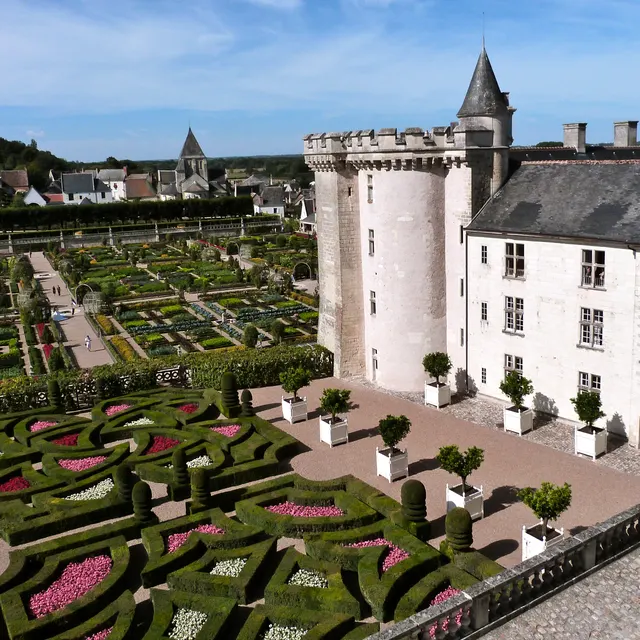 The Château InteriorThe château itself is more modest than its gardens, in keeping with Villandry's standing as the last, and one of the least ostentatious, of the great Renaissance houses on the Loire.
The château itself is more modest than its gardens, in keeping with Villandry's standing as the last, and one of the least ostentatious, of the great Renaissance houses on the Loire. The combined château-and-gardens visit takes in the furnished interior, which reflects the building's long history from Jean Le Breton onward through its later owners. Among the rooms shown are a gallery of Spanish paintings assembled by Joachim Carvallo and a richly decorated oriental ceiling of Moorish origin, both reminders of the Spanish doctor who rescued the estate in the early twentieth century. Crucially, the interior visit also gives access to the surviving medieval keep, the single best vantage point over the potager's geometric pattern spread out below.
For visitors weighing the gardens-only option against the combined visit, the honest guidance is simple. The gardens are Villandry's headline attraction and stand entirely on their own, so a gardens-only visit is a complete and satisfying trip in its own right, and it remains possible in the weeks when the interior is closed for seasonal work. The combined visit adds the historical rooms and, most usefully, that aerial view of the potager from the keep, which is worth the extra for anyone who wants the classic photograph looking straight down over the nine squares, or who has a general interest in the architecture and story of the house. Either way, the gardens are the reason to come, and the interior is the rewarding addition rather than the main event.
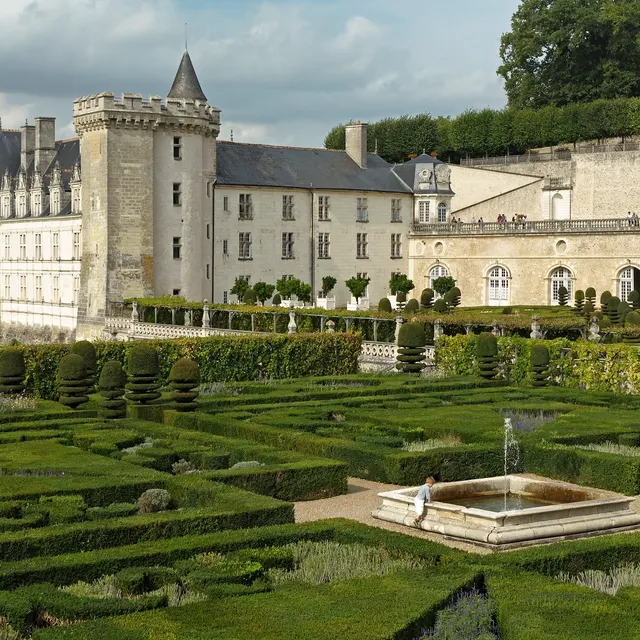 When to VisitVillandry rewards seasonal planning more than almost any other Loire château, because its main attraction is a living garden rather than a fixed building.
Villandry rewards seasonal planning more than almost any other Loire château, because its main attraction is a living garden rather than a fixed building. Late spring, in April and May, shows the first, softer planting of the potager and usually comes with thinner crowds than high summer. June through September is the peak season for both colour, with the bold cabbages, pumpkins and gourds of the second planting, and for visitor numbers, with July and August also bringing the one direct seasonal shuttle from Tours. Late September brings the estate's own Vegetable Garden Days and rich harvest tones with noticeably fewer visitors than midsummer, which makes early autumn one of the best-value windows of the year.
Winter strips the potager back to bare soil and box-hedge structure, appealing mainly to visitors more interested in the geometry of the design, the maze, or simple off-season quiet than in full colour. Within any single visit, the light is best in the morning and late afternoon, raking across the terraces and giving the clearest view of the potager's pattern from above. The gardens are open every day of the year except 25 December, while the château interior closes for short seasonal breaks, typically around January into February and again in mid-to-late November. Because exact opening dates and hours vary through the year and can change, it is worth confirming the current schedule before you travel, and choosing the gardens-only option if you plan to visit during an interior closure.
 Getting ThereVillandry sits about 15 km west of Tours, one of the closer great Loire châteaux to the city, which makes it a realistic half-day trip.
Villandry sits about 15 km west of Tours, one of the closer great Loire châteaux to the city, which makes it a realistic half-day trip. By car it is roughly a twenty-minute drive, with parking near the entrance. In July and August, the local Fil Bleu network runs a daily seasonal shuttle bus directly from Tours; outside those months, most visitors without a car rely on a taxi, an organised minibus tour combining Villandry with other châteaux, or arrive by bicycle. The estate lies directly on the well-marked Loire à Vélo cycle route, and the ride out from Tours is a flat stretch of around 15 km along the river valley, popular with visitors touring several châteaux by bike over a few days.
From Paris, the fastest approach is the high-speed TGV from Paris Montparnasse to Tours or Saint-Pierre-des-Corps, a journey of a little over an hour, followed by a taxi, hire car or the summer shuttle for the final leg. Driving direct from Paris covers roughly 240 km by way of the A10 and A85 motorways, about two and a half hours outside peak traffic. Because the château is compact and close to Tours, it pairs naturally with a second Loire château on the same day for those with their own transport. Timetables and seasonal services change, so it is sensible to check current schedules before setting out, particularly if you are relying on the summer shuttle or on public transport outside the peak months.
 Visiting with FamilyVillandry is one of the more genuinely family-friendly Loire châteaux, largely because the gardens give children something active to do rather than requiring them simply to look and listen.
Villandry is one of the more genuinely family-friendly Loire châteaux, largely because the gardens give children something active to do rather than requiring them simply to look and listen. The hornbeam maze is the standout attraction for younger visitors: the goal is immediately understandable, reach the central tower and look back down, and it works for a wide range of ages, with a shortcut for anyone who tires before the end. The sun garden's playground offers a proper rest stop with play equipment rather than just open lawn, which matters on a visit that otherwise involves a fair amount of careful terrace walking.
The estate also provides a book-game aimed at children of around seven to twelve, handed out at the ticket desk, that turns the garden circuit into a set of riddles and activities, along with an audio guide with content adapted for children. Younger children generally enter free, which meaningfully changes the economics of a family day out compared with châteaux that charge for every age. A few practicalities help a family visit go smoothly. Pushchairs work well across the gravelled garden terraces but are generally not permitted inside the château interior, worth planning around if you are visiting with a baby or toddler and want to see the rooms as well as the gardens. In warmer months the open terraces offer little shade, so a late-afternoon visit, when the light softens and the day-trip crowds thin, tends to suit families with young children best.
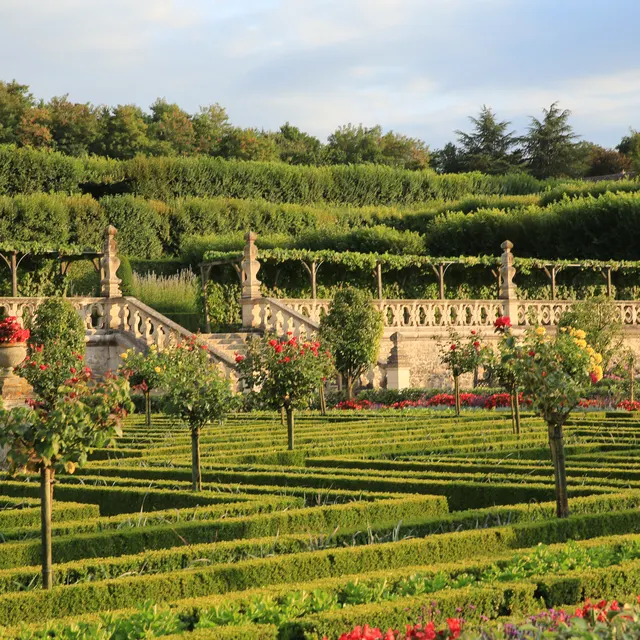 Practical TipsAllow around one and a half to two hours for a combined visit to the gardens and château; garden enthusiasts and photographers often stay considerably longer, especially at the height of the planting season.
Allow around one and a half to two hours for a combined visit to the gardens and château; garden enthusiasts and photographers often stay considerably longer, especially at the height of the planting season. The gardens are largely accessible along gentle gravelled terrace paths, though the château interior involves stairs to its upper floors, so if you have specific access needs it is worth checking the current arrangements with the estate before you travel. The design is meant to be read from above, so make a point of climbing to the upper terraces or the medieval keep for the classic view down over the potager's nine squares; the morning and late-afternoon light shows the patterns at their clearest.
There are cafés in the village and picnic-friendly spots near the car park, and a seasonal tea room operates on site during the main season, so it is easy to make a half-day of the visit. Personal photography is generally welcome throughout the gardens, where the elevated view over the potager is the classic shot, though it is worth checking the current rules for the château interior on the day, as they can vary for temporary exhibitions. Opening hours and seasonal closures change through the year, so confirm the current schedule before you set out, and choose the gardens-only option if you are visiting in one of the short windows when the interior is closed. Above all, plan for a relaxed pace: Villandry rewards slow looking far more than a brisk circuit, and the gardens reveal their detail to those who linger.
Practical
The linden pergola
Opening hours
The gardens open every day except 25 December; the château interior opens 7 February–11 November and 28 November 2026–3 January 2027. Hours vary by season — gardens roughly 09:00–19:00 in summer (April–September), shorter in winter. The château interior closes for short periods in January/February and mid-to-late November, when the gardens stay open. Last château entry is 30 minutes before closing.
Address
Château de Villandry, 3 rue Principale, 37510 Villandry, France
Getting there from Tours
Villandry is about 15 km west of Tours. In July and August a daily Fil Bleu shuttle bus runs from Tours; the rest of the year there is no direct bus or train to the village, so most visitors come by car, taxi or bike.
Getting there from Paris
TGV from Paris Montparnasse to Tours or Saint-Pierre-des-Corps (about 1h15), then a taxi, seasonal shuttle or hire car for the final 15 km.
Getting there by car
About 20 minutes from Tours. Free parking near the entrance. The château sits on the Loire à Vélo cycle route for those arriving by bike.
Time needed
Allow around 1.5–2 hours for the gardens and château. Garden lovers easily spend longer, especially in summer.
Accessibility
The gardens are laid out on gentle gravelled terraces and are largely accessible; the château interior has stairs to the upper floors. If you have specific access needs, ask us before you book and we'll check the current arrangements with the estate.
Photography
Personal photography is generally welcome in the gardens — the view down over the patterns from the terraces is the classic shot. Check the current rules for the château interior on the day.
Food
There are cafés in the village and picnic-friendly spots near the car park; a seasonal tea room operates on site in the main season.
Included with every ticket
Your Villandry 5-minute guide
Hand-written, narrated by a heritage host, sent to every customer the day before their visit. Five minutes on how a Spanish doctor rescued a half-ruined château and rebuilt the most famous Renaissance gardens in France — and how to read the patterns from the terrace above.
Included free with every ticket. No app, no download — plays in any browser.- Why the gardens, not the château, made Villandry famous
- Joachim Carvallo and the early-1900s rescue of a Renaissance layout
- How to read the potager's nine squares — and why it's replanted twice a year
- The best terrace to look down over the whole design
Guides
Clearings in the hornbeam maze
-
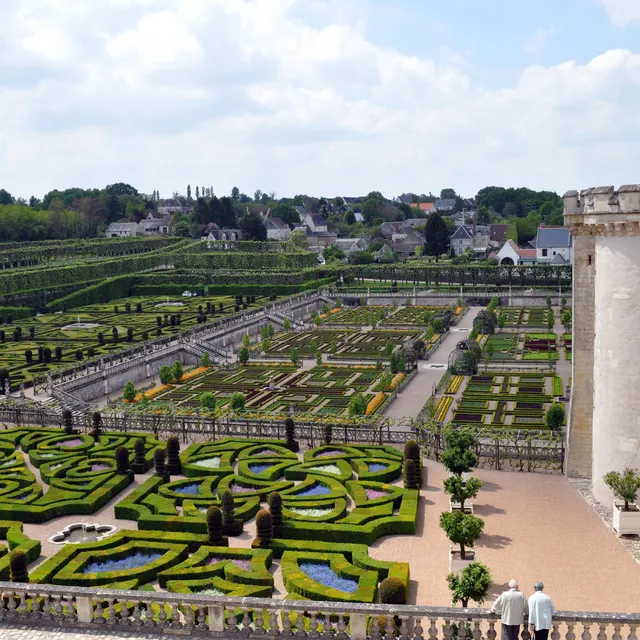 The Best Time to Visit Château de Villandry 4 min · Read the guide →
 -
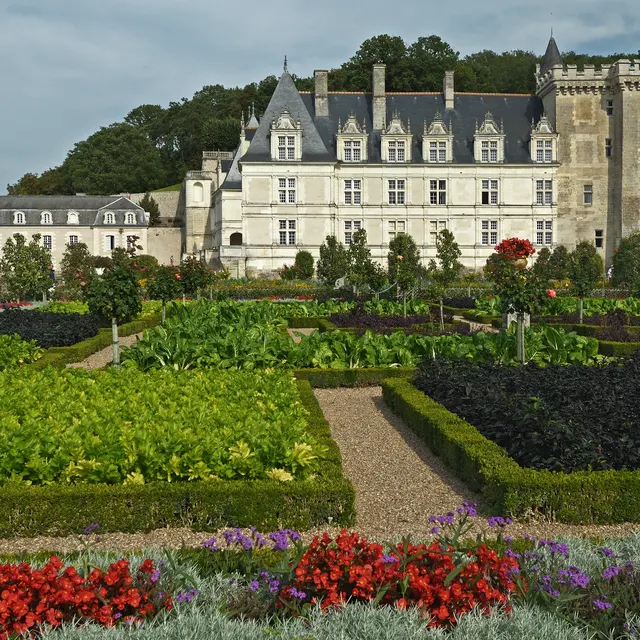 How to Get to Château de Villandry 3 min · Read the guide →
 -
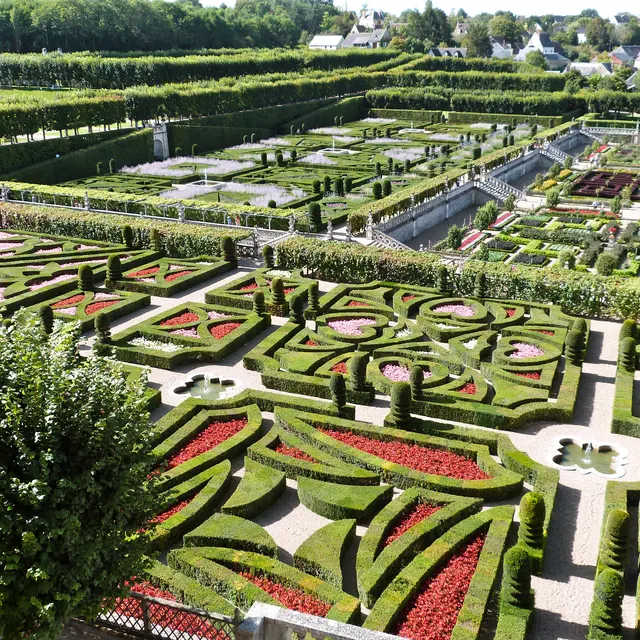 What to See at Château de Villandry — Gardens and Château 3 min · Read the guide →
 -
 Château de Villandry with Kids 3 min · Read the guide →
 -
 Villandry vs Chenonceau — Which Should You Visit? 3 min · Read the guide →
Questions
The nine squares
1What's included in the ticket?
Two options. The Château + Gardens ticket covers the Renaissance interior and all six gardens; the Gardens-only ticket covers the gardens without the château interior. Both arrive as an e-ticket by email.
2Do I need to choose a date and time?
No. Villandry tickets are open-dated with no time slot, so you can visit on any open day. There's no calendar to lock in when you book.
3Is this a skip-the-line ticket?
Villandry has no timed entry and no daily cap, so there's rarely a queue to get in. Your e-ticket lets you scan straight through without buying at the ticket desk.
4When are the gardens at their best?
Late spring to early autumn. The ornamental kitchen garden is replanted twice a year, so June and September look quite different — both are worth it.
5Is the château interior always open?
Almost. The interior closes for short periods in January/February and mid-to-late November for seasonal work. The gardens stay open in those weeks, so choose the Gardens-only ticket if you're visiting then.
6Château + Gardens or Gardens only — which should I pick?
Villandry is famous for its gardens, so Gardens-only suits garden lovers short on time. Château + Gardens adds the furnished Renaissance interior and the keep, where you get the best view down over the garden patterns.
7How do I get there from Tours?
It's about 15 km west of Tours. In July and August a daily Fil Bleu shuttle runs from Tours; otherwise it's a 20-minute drive or taxi, or a ride along the Loire à Vélo cycle route.
8Do you sell child or reduced tickets?
We sell the full-price adult ticket. Youth, student, reduced and under-8 (free) categories are booked directly at the château with proof of eligibility — we're glad to point you to the right place.
9What if my plans change?
Because the tickets are undated and valid all season, you can simply go on another open day. All sales are final, except that we refund in full if the château cancels.
The garden gate
A few more before you go.
Sources: chateauvillandry.fr, whc.unesco.org, en.wikipedia.org Last reviewed: